
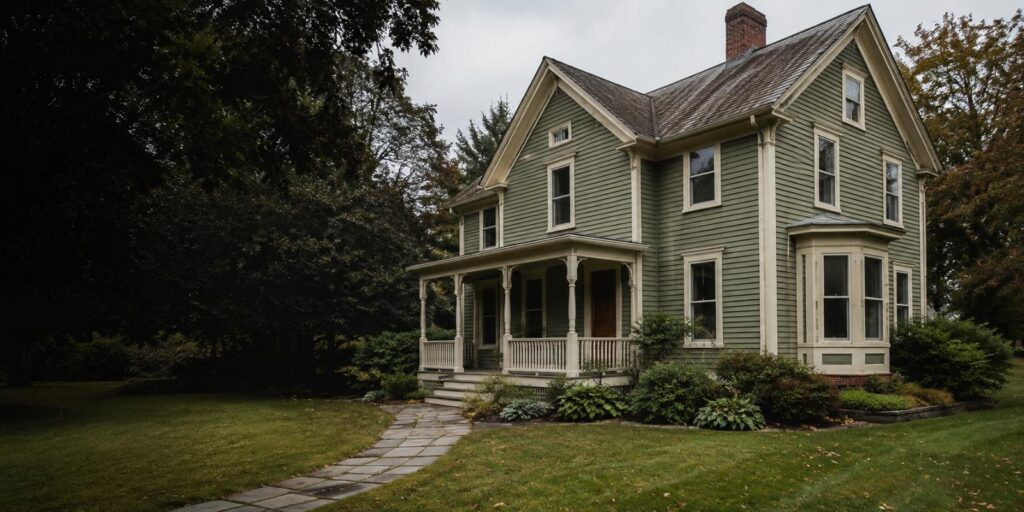

When you walk into the basement of a 150- or 200-year-old New England home, the foundation can look very different from what you would expect to see in a modern house. Irregular stones, aging mortar, patched surfaces, signs of moisture, and decades—or centuries—of repairs can make an old foundation appear concerning at first glance.
But old does not automatically mean defective.
The more useful question is whether the foundation is performing as intended, how it has changed over time, and whether there are conditions that require maintenance, repair, or further evaluation.
At Historic Home Inspections, this is an important part of inspecting older homes throughout Rhode Island and Southern Massachusetts. Understanding these foundations means understanding how they were originally built, the materials used to build them, and how those materials behave as they age.
Stone Foundations Were Built Differently
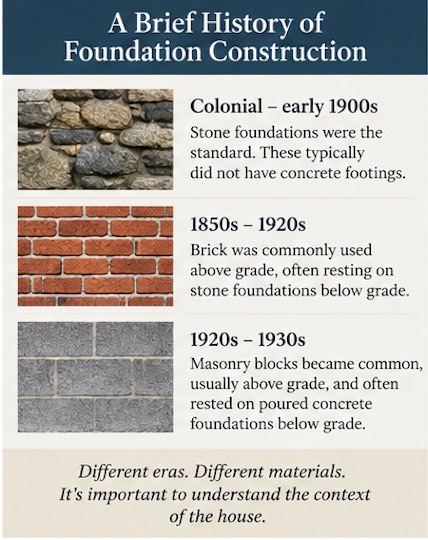
Stone foundations were standard in the United States from colonial times through the early 1900s. Unlike modern poured-concrete foundations, these older foundations commonly did not have the type of concrete footing we would expect beneath a modern foundation wall. Builders excavated the site and constructed the stone walls from there.
The materials also changed as building practices evolved.
In homes built from roughly the 1850s through the 1920s, it is common to find stone below grade with brick masonry above it. Masonry block became common during the 1920s and 1930s, often above grade with poured concrete below.
For a homebuyer, that history matters.
We should not evaluate a foundation built in 1820 as though someone poured it in 2020. At the same time, age should never be used as an excuse to dismiss deterioration or movement.
The goal is to understand what we’re looking at in the context of the house.
What Do We Look for During an Inspection?
One of the first things we examine is the condition of the mortar between the stones or bricks.
On the exterior, even relatively minor mortar deterioration deserves attention because the mortar helps protect and maintain the masonry assembly. Inside a stone foundation, we continue looking for deteriorated mortar as well as deterioration of the coating—or skim coat—that may cover portions of the foundation wall.
But deterioration isn’t the only concern.
An especially useful question when inspecting an old masonry foundation is:
Are the stones and bricks still where the original builder put them?
Movement can be obvious, but it can also be subtle. Bulging or leaning walls, sagging areas, loose stones or bricks, and other displacement can indicate conditions that deserve closer attention.
A home inspection is not a structural engineering analysis. When movement or significant deterioration raises a possible structural concern, further evaluation by an appropriate qualified professional—and, where warranted, a structural engineer—may be recommended.
That distinction is important. Our job isn’t to make an old foundation sound frightening. It’s to identify visible conditions, put them into context, and help the buyer understand what the appropriate next step may be.
Don’t Overlook the Skim Coat
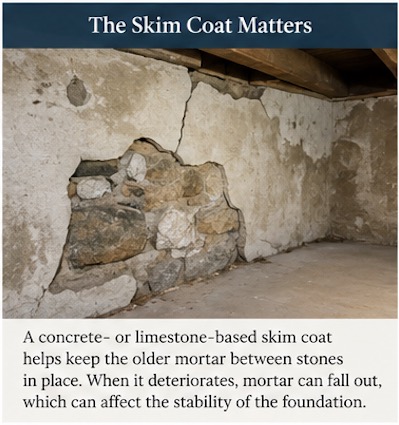
One feature buyers may not recognize as important is the coating found over many stone foundation walls.
A concrete- or limestone-based skim coat can help keep the older mortar between the stones in place. As that coating deteriorates, mortar can begin falling out from between the stones, contributing to deterioration and settlement. The coating also helps seal the wall against moisture moving through the foundation.
That means a deteriorated skim coat isn’t necessarily just a cosmetic issue.
During an inspection, we look for areas where the coating is cracked, missing, loose, or deteriorated, along with exposed or deteriorating mortar underneath.
We also need to recognize the limits of what can be inspected. Finished basement walls, insulation, stored belongings, crawlspace coverings, and other obstructions may conceal portions of an older foundation. Those limitations matter because conditions behind them cannot be directly observed.
Water Management Matters—A Lot
Many foundation problems don’t begin with the foundation itself.
They begin with water.
Leaking gutters and poorly directed downspouts can contribute to deterioration of old brickwork. Improper grading and erosion around the perimeter can also negatively affect an older foundation.
Inside the basement, evidence of seepage can tell another part of the story. Loss of mortar and silt associated with water movement can indicate that moisture isn’t simply making the basement damp—it may also be affecting the masonry itself.
This is why we don’t inspect a foundation in isolation.
We look outside.
Where does the roof water go? Are the gutters leaking? Where do the downspouts discharge? Does the ground slope toward or away from the house? Is there erosion beside the foundation?
The condition observed in the basement may be connected to something happening several feet away on the exterior.
And this lesson isn’t limited to historic homes. Managing water around the foundation is important whether your house was built in 1820, 1920, or 2020.

The Mortar Matters Too
One of the more interesting differences between historic and modern masonry is the mortar itself.
Lime-based mortar was standard from colonial times through the end of the 1800s. Portland cement became commercially available in the United States in the 1870s, but according to our training material, it was primarily used as an additive to lime mortar until the 1930s. Traditional lime mortar is substantially softer than Portland-cement-based mortar.
Why should a homeowner care?
Because when historic masonry needs repointing, stronger isn’t necessarily better.
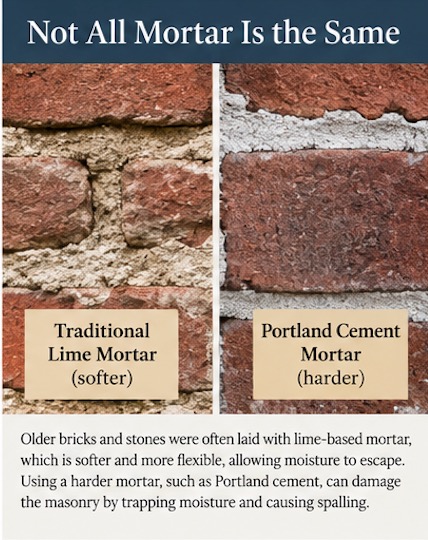
Using a mortar that is too hard for older, softer brick or certain stone can contribute to deterioration. Traditional lime mortar allows moisture to move through the mortar and has more flexibility than harder Portland cement. With an incompatible harder mortar, moisture can instead migrate through softer masonry, contributing to spalling and deterioration.
For that reason, the original materials matter when repairs are being considered. Our training generally recommends lime-based mortar for exterior repointing of historic brick and stone foundations exposed to weather, while Portland-cement-based mortar and skim coats may be appropriate in basement applications.
A qualified mason familiar with historic masonry should determine the appropriate repair materials and methods for the particular foundation.
When Does an Old Foundation Need More Attention?
There isn’t one defect that determines whether an old foundation is “good” or “bad.”
Instead, we look at the overall picture.
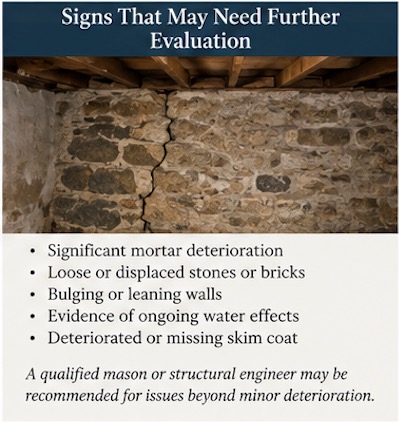
Minor mortar deterioration may represent maintenance. More significant mortar loss, loose masonry, deteriorated skim coating, evidence of ongoing water effects, or visible movement can justify professional evaluation and repair. Where the observed conditions suggest a possible structural issue, evaluation and recommendations from a structural engineer may be appropriate.
That is one of the reasons experience with older construction matters.
A foundation can look rough and still have been supporting a house for generations. Conversely, something relatively subtle can sometimes provide evidence of a more meaningful problem.
Age alone doesn’t answer the question. Condition does.
Buying an Older Home? Understand It Before You Judge It.
Historic and older homes weren’t built with today’s materials or construction methods. That’s part of what makes inspecting them different.
Stone foundations, lime mortar, brick masonry, skim coats, old repairs, moisture, and generations of modifications all tell part of the story of the house.
A good inspection shouldn’t make a buyer afraid of that history.
It should help the buyer understand it.
At Historic Home Inspections, we specialize in older and historic homes while inspecting homes of every age throughout Rhode Island and Southern Massachusetts. Our goal is to help clients understand what they’re buying, recognize the conditions that deserve attention, and make informed decisions about their home.
Older homes are different. Understanding those differences matters.
READY FOR YOUR HOME INSPECTION?
Schedule with Historic